Giveth connects crypto donors with projects that need funding
Giveth connects cryptocurrency donors with fundraising projects through direct wallet donations that carry no platform fee. Projects can publish their funding goals, while donors choose how to support them. Recurring donations, pooled Causes, GIV token tools, and matching rounds offer additional ways to contribute, each with separate requirements.
In short: A project can receive direct donations only on its accepted networks, even when the wider platform supports additional chains.
Project fundraising and recipient wallets
A fundraising project combines its funding purpose with one or more recipient wallets. The creator supplies a name, description, relevant categories, impact location, and image. These details explain the work that donations will support and help people find projects that match their interests.
Recipient addresses determine where direct donations go. Project owners choose their accepted networks and can set different receiving addresses where needed. Each address must belong to a wallet that the project controls. The creation process warns against using an exchange deposit address.
Publication and verification are separate processes. A published listing does not automatically receive the Verified or GIVbacks Eligible badges. Verification concerns project legitimacy, while GIVbacks eligibility adds a review of its public benefit.
Three attestations from Giveth Verifiers on DeVouch or approval from the verification team can establish Verified status. GIVbacks eligibility requires approval of an application describing the project’s actual work and intended impact. Projects must post updates at least every 90 days to maintain eligibility; the badge expires after three months of project inactivity. A clear description also lets donors assess the proposed use of funds beyond the badges displayed.
Direct donations across supported networks
Direct donations transfer cryptocurrency from a donor’s wallet to the recipient wallet that a project has configured. Network support includes Ethereum, Gnosis Chain, Arbitrum, Base, Celo, Optimism, and Polygon PoS. Solana and Stellar provide additional donation options with their own wallet requirements. Individual projects may accept only some supported networks. Token availability also depends on the selected network and donation method. A token that a donor holds must match an option that the project can receive. The interface can warn when a wallet connects to a network that the project does not accept.
Processed donations have transaction details accessible from the confirmation page. Public blockchain records expose the transfer between addresses. Those records show where funds moved; project descriptions and progress updates address the separate question of what the recipient does with them.
Recurring support through token streams
Recurring donations use Superfluid streams on Optimism or Base, with a recipient project that accepts the relevant network. A donor deposits an eligible token into its Stream Balance, which holds the corresponding Super Token. Upgrading and downgrading use a one-to-one token ratio. An x suffix distinguishes the streaming token from its underlying asset.
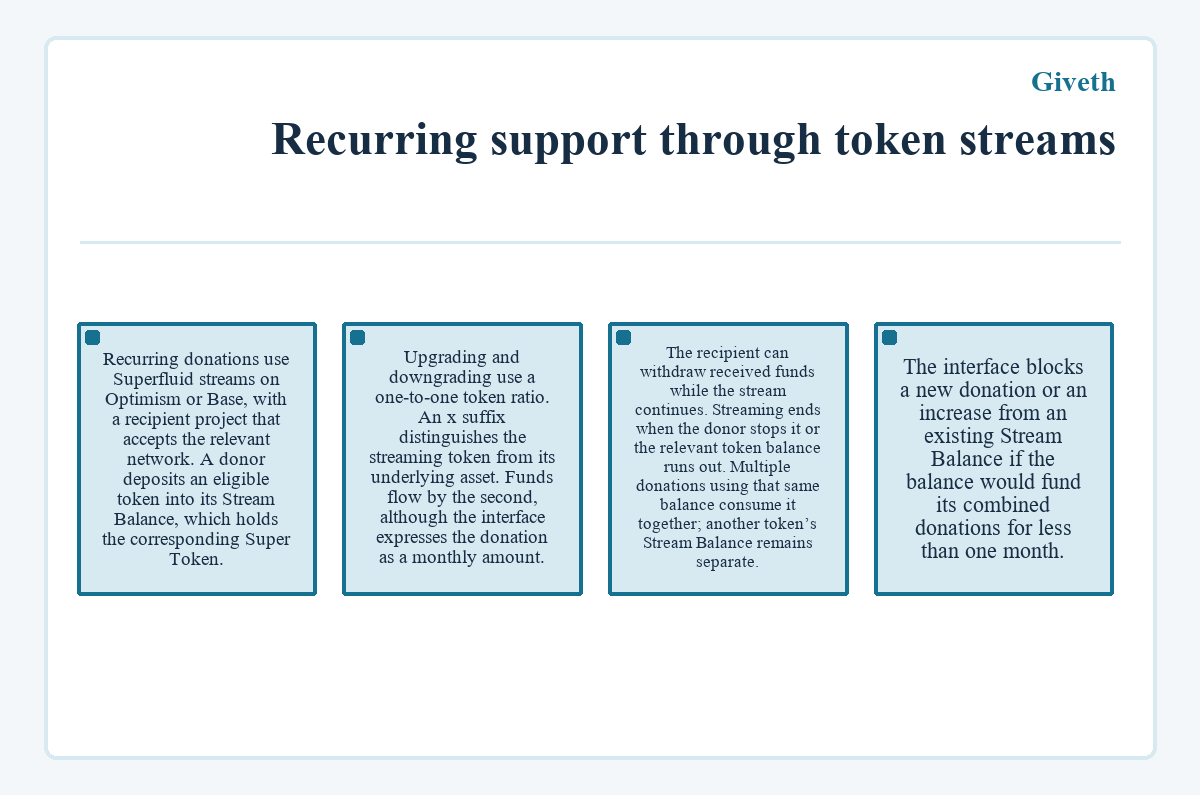
Funds flow by the second, although the interface expresses the donation as a monthly amount. The recipient can withdraw received funds while the stream continues. Streaming ends when the donor stops it or the relevant token balance runs out. Multiple donations using that same balance consume it together; another token’s Stream Balance remains separate. The interface blocks a new donation or an increase from an existing Stream Balance if the balance would fund its combined donations for less than one month.
GIV tokens, project visibility, and donor rewards
The GIVeconomy connects GIV with governance, project curation, and donor rewards. GIV is a transferable ERC-20 token.
Project curation with GIVpower
GIVpower comes from staking GIV on a supported staking network. Token holders allocate it to boost verified projects and influence fundraising rankings. Optional locks multiply GIVpower for the affected staked tokens and prevent unstaking until their unlock date. Staking supports project visibility; direct donations fund a recipient.
GIVbacks raffle eligibility
GIVbacks uses a raffle model that began with Round 77 on November 26, 2024. Qualifying donations worth at least US$5 to GIVbacks Eligible projects during an active round can earn eligible donors raffle entries. Token eligibility and donor exclusions also apply. The donation amount and the project’s GIVpower determine the number of raffle entries. A qualifying contribution offers a chance to win GIV, without promising a fixed percentage rebate.
GIVstream reward releases
GIVstream releases GIVeconomy rewards over time under an emission schedule ending on December 23, 2026. This reward distribution differs from recurring donations, which stream funds from a donor’s funded token balance to a project.
Matching pools and Cause allocations
Quadratic funding adds matching money to qualifying projects, while Causes collect donations into a pool for managed distribution.
Quadratic funding
Quadratic funding considers contribution amounts and distinct contributors when allocating a separate matching pool. Each round sets its own project requirements, supported networks, donation minimums, and donor-eligibility conditions.
Participation requirements
A qualifying contribution must reach an eligible project during the active round and meet that round’s network and minimum-donation rules. Donors must complete the applicable Passport eligibility verification before the round ends. Each matching pool also allocates at least 15% to the team’s round operations and management.
Matching estimates
Matching estimates reflect donations received so far and applicable project caps. They exclude some eligibility and post-round disqualification checks. Final matching follows the round’s close and review, so an estimate is not an amount that the project has already received.
Cause pools
A Cause groups projects into a shared pool that an AI-powered Donation Agent manages. The agent assesses project information, updates, social activity, and GIVpower when allocating support. The Cause donation route bridges and swaps contributions into GIV on Polygon through Squid Router. Each daily distribution draws 5% of the Cause pool’s current balance. Of that distribution, 92% goes to selected projects, 5% goes to Giveth, and 3% goes to the Cause creator. These percentages describe the distributed portion, rather than an immediate division of the whole contribution.
What does a direct crypto donation cost?
Giveth charges no platform fee on direct donations to project wallets. Blockchain network fees still apply and vary with the selected chain and its conditions. The recipient receives the direct donation without a platform deduction, while the donor pays the network processing cost. Project creation and receipt of direct donations also carry no platform charge. Cause distributions and quadratic matching pools have the separate funding allocations that apply to those mechanisms.
Choosing support that matches the project
A project marked Verified can qualify for GIVpower boosting without being GIVbacks Eligible. Boosting supports its fundraising visibility; a reward-qualifying donation needs the additional status and donation conditions. The payment method then determines how the funding reaches the project.
- For a direct gift, choose a token and network that the recipient project accepts.
- For recurring support, use an eligible project on Optimism or Base and maintain the relevant Stream Balance.
- For GIVbacks entry, require GIVbacks Eligible status, an eligible token, a qualifying amount, an active round, and donor eligibility.
- For quadratic matching, satisfy the round’s project, network, minimum-donation, and donor-eligibility rules before its closing deadline.
- For a Cause, account for pooled allocation in GIV and the project, platform, and creator funding split.
A direct gift lets the donor select the recipient project. A Cause contribution leaves allocation among its participating projects to the Donation Agent.
Giveth: quick answers
Can I donate from a different wallet than the one used to sign in?
The donation wallet can differ from the wallet that you used to sign in. The account menu includes a Change wallet option for selecting another wallet. The selected wallet needs funds on a network that the recipient project accepts.
Is a connected wallet necessary for a Stellar donation?
The Stellar donation flow does not require connecting a wallet or creating a Giveth profile. A Stellar wallet still provides the XLM payment, either by scanning the displayed QR code or using the recipient details.
Which memo belongs on an XLM donation?
Use the memo displayed for the specific Stellar donation request when that request requires one. The payment instructions state whether a memo is necessary. Copy the recipient details from that request and include its required memo when sending; some requests explicitly state that no memo is needed.
When should a Stellar donation appear in project statistics?
A sent Stellar donation may take up to 15 minutes to appear on the project page and in round statistics. The Stellar payment request also has a separate 15-minute completion window. If that payment window expires before you send the donation, restart the donation process to generate a new QR code. A display delay and an expired payment request are different states.
Where can an owner edit a published project description?
Published project descriptions remain editable through My Projects in the account menu. Each project has an Edit option for changing its content and saving the revision. Keeping the description current helps communicate the work and funding purpose without creating another project listing.
Will topping up a depleted Stream Balance restart recurring donations?
A top-up alone does not restart recurring donations that ended when their Stream Balance ran out. The donor must fund the relevant token balance and create a new recurring donation. The interface blocks creation if that balance would cover less than one month of its combined donations. Adding funds while a stream remains active instead extends how long that existing balance can sustain its donations.
Must a project register as a nonprofit to apply for GIVbacks eligibility?
GIVbacks eligibility applications accommodate projects that are not registered nonprofit organizations. Those projects must explain their structure and demonstrate public benefit and actual work. Registered nonprofits must provide verifiable registration evidence. Nonprofit registration alone does not replace the project’s eligibility review.
Does donating from a project’s receiving address earn GIVbacks?
GIVbacks Eligible project addresses do not receive GIVbacks for donations to their own project or another GIVbacks Eligible project.